
Beautiful weather, good food & good company – sounds like summer, right? One might even say such a combination deserves a refreshing drink to complete the experience like the timeless Cuba Libra (better known as a Rum & Coke), but the real key to enjoying such experiences is in sharing good times with our fellow people & being together.
Unfortunately, while the browsing experience on Havana Club’s website seems to be a lively party on mobile they seem to have missed the mark on having their site provide an inclusive and responsive experience for people of all cognitive abilities with their non-functional media controls on larger screens. We all love an immersive digital experience, but let’s not forget about our friends & family members who might not be up for the flashy graphics and fancy animations as part of their own browsing experiences for reasons varying from what could be motion-based sensitivities (such as vestibular vertigo among others) to simply personal preference. Broader society has made significant progress over the years of trying to ensure that ableism does not guide the way we think & that has helped in building a more inclusive, accessible world around us but there is still work to be done.
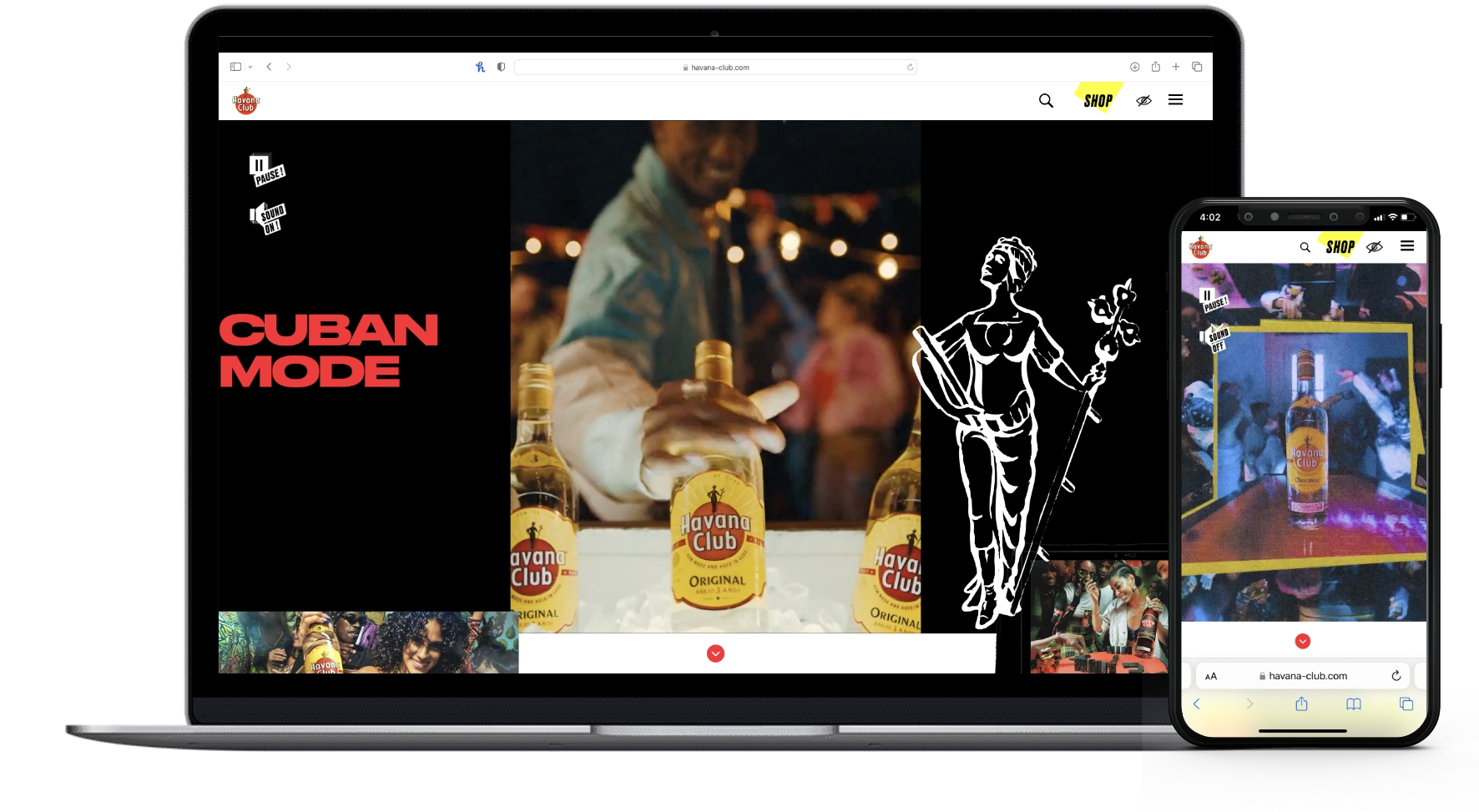
Image source: www.havana-club.com
One way to help ensure your website experience is accessible (and contributing positively to the growth of the web!) is to make sure it meets Web Content Accessibility Guidelines – also commonly referred to as WCAG. While we know & understand that trying to tackle all potential accessibility issues with a site at once may not be feasible, there are four core principles which would serve as a great starting point towards that goal and that is to make sure your content is POUR (Perceivable, Operable, Understandable & Robust). In the case of Havana Club’s website, their non-functional media controls on larger screens are in violation of at least 2 of these principles by way of the absence of a way to pause or stop an HTML5 media element that autoplays (Perceivable) as well as all functionality of the content is operable through a keyboard interface without requiring specific timings for individual keystrokes (Operable). While certainly not the only reason you should ensure your website meets WCAG accessibility standards, it is also a mandatory requirement in Canada that all online web pages, documents and videos available externally and internally meet the accessibility guidelines of WCAG 2.0. There are existing requirements of a similar nature in the European Union, United Kingdom, Australia & Israel among other global considerations.

Taking smaller steps such as consistently ensuring our digital experiences are people-friendly across a wider variety of use cases through something as simple as providing explicit “opt-in/opt-out” controls for media playback in addition to ensuring functionality remains consistent is just one way we can help to do our part in both keeping the forward momentum going towards a more accessible digital world while also ensuring our fellow people of different abilities don’t have to miss out on the party because as has always been the case – especially in our post-pandemic world – being able to share these experiences with our fellow people is what truly makes our times together special!
Thanks for reading! Check out more of our Website Nightmares here!